DATAGOV Blog
Here you can find works in progress, exploratory notes, and thoughts on current affairs in data infrastructures.
Dissecting Digital ID(ea)s
What Digital Identity Systems Tell Us About Power, Governance, and Everyday Life
Digital identity systems are quietly becoming the backbone of contemporary governance. From logging into public services to accessing welfare and healthcare services, digital IDs increasingly shape who gets access to what. Despite their growing importance, these systems are often framed as neutral technical upgrades rather than politically charged infrastructures.
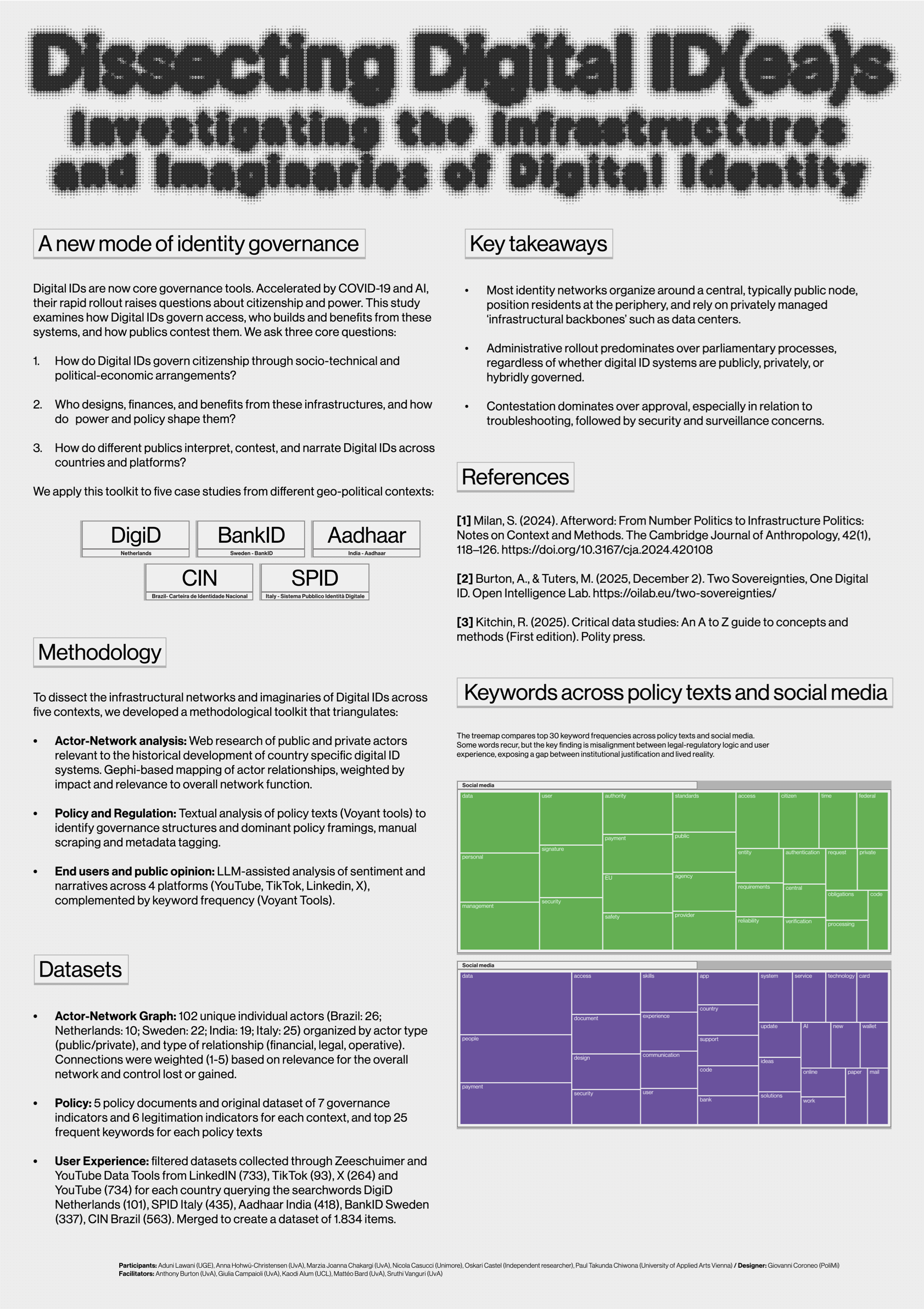
At the DMI Winter School 2026 , three of us facilitated a collaborative project titled Dissecting Digital ID(ea)s: Investigating the Infrastructures and Imaginaries of Digital Identity. Over a week-long data sprint, participants worked together to unpack how digital ID systems are built, legitimized, and contested across different national contexts.
Rather than treating digital IDs as single technologies, we approached them as socio-technical assemblages, by which we mean the complex of national policies, public institutions, private companies, and rhetorics sustaining the implementation of the technology in our everyday lives. The project focused on five national ID systems: DigiD (Netherlands), BankID (Sweden), SPID (Italy), Aadhaar (India), and CIN (Brazil) , chosen to reflect different governance models and political trajectories.
Following the Infrastructure
One of our starting questions was deceptively simple: who actually builds and governs digital ID systems? Using actor-network analysis, participants mapped the public and private actors involved in designing, maintaining, and operating these infrastructures.
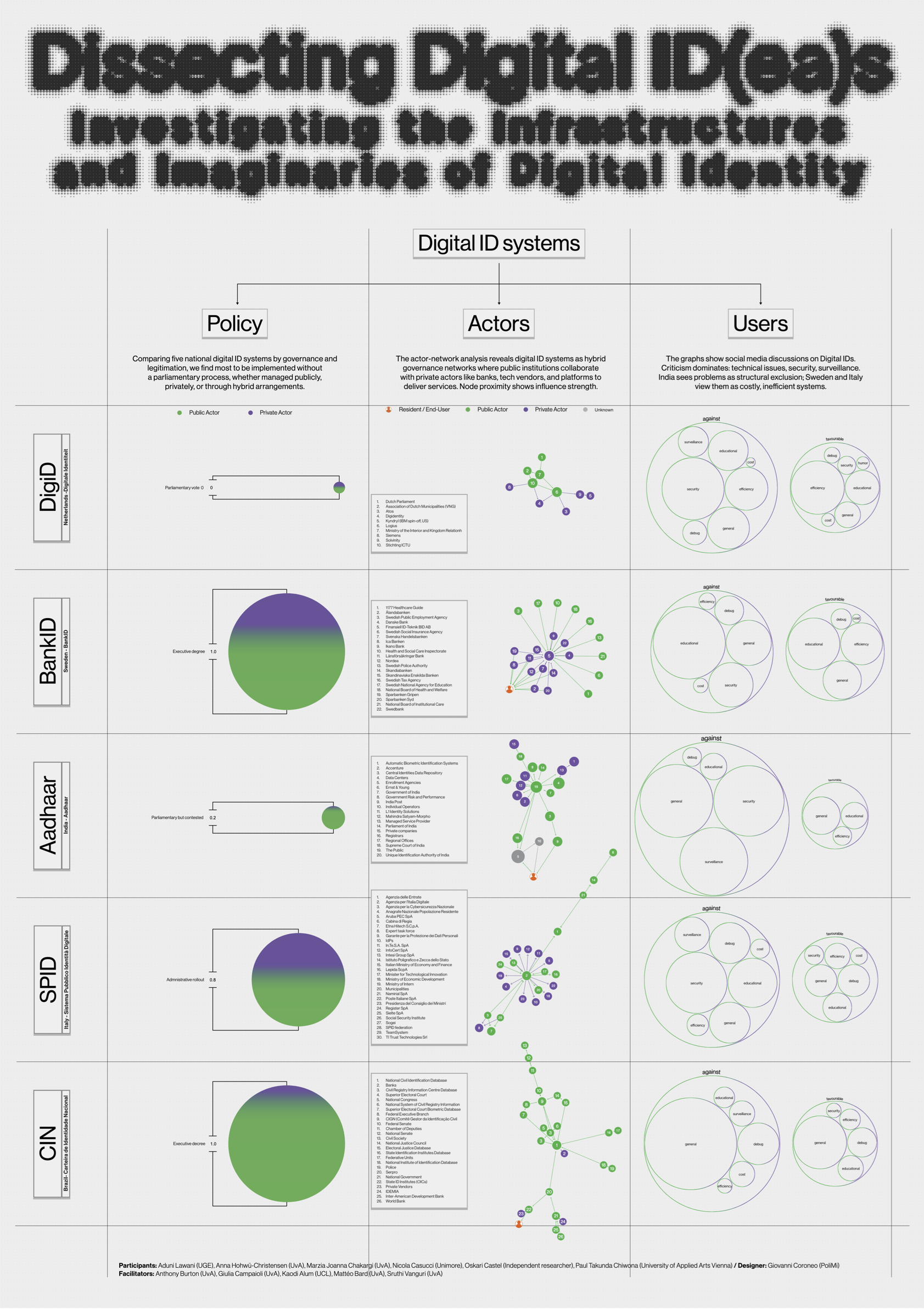
Across all cases, one pattern stood out clearly. No digital ID system is built entirely in-house by the state. Even where governments retain formal authority, key components of the making and maintaining of the technology are delegated to private actors. Digital ID systems emerge as hybrid governance infrastructures, combining public authority with privately operated technological backbones.
Sweden’s BankID represents the most extreme version of this arrangement. Banks have not only built the system but also control access to it, leaving public institutions contractually dependent on private infrastructure to deliver essential identification services. At the other end of the spectrum, countries like the Netherlands and Brazil attempted to keep digital ID infrastructures largely publicly controlled, yet they still outsourced some technical components.
Interestingly, users themselves appear at the margins of these actor networks. While citizens and residents are usually the end-users, and often the ones most affected by system failures or exclusions, their role in shaping digital ID infrastructures is minimal.
Governance Without Debate
A second major finding concerns how digital ID systems are introduced and legitimized. Comparing policy documents across countries, we found that most digital IDs were rolled out through administrative or executive processes, rather than parliamentary debate . In several cases, systems were already operational before comprehensive legal frameworks were in place.
This mode of rollout varies systematically with governance arrangements. In cases where digital ID systems remain fully publicly governed, parliamentary approval accompanied their introduction. By contrast, when systems are hybrid or privately dominated, rollout largely occurred through administrative or executive pathways, often preceding comprehensive legislative frameworks.
This suggests a broader shift: digital IDs are increasingly treated not as policies to be debated, but as infrastructures to be deployed. Their legitimacy stems from technical implementation rather than democratic deliberation, raising important questions about accountability and participation in data-driven governance.
What Users Say Online
To understand how digital IDs are experienced by end-users, participants analysed discussions across four major social media platforms (X, YouTube, LinkedIn, and TikTok). Across all countries, contestation dominated over approval in the online public arena. Rather than ideological, criticism was grounded in usage challenges: system breakdowns, access problems, security concerns, and confusion.
Yet the meaning of this critique varies across contexts. In India, discussions around Aadhaar frame technical issues as forms of structural exclusion, especially where access to welfare depends on successful authentication. In Italy and Sweden, criticism focuses more on inefficiency and cost. In Brazil, much of the discourse revolves around debugging and surveillance concerns. In the Netherlands, DigiD is discussed both as an efficient everyday tool and as a potential security risk.
Across cases, social media emerges as a parallel arena of governance, a place where users troubleshoot, share knowledge, and voice concerns largely absent from formal policy debates.
A Growing Gap
When we compared policy documents with social media discourse, a clear misalignment emerged. Policies emphasize design, access, and efficiency; users talk about security and everyday friction. This gap reflects a broader tension wherein digital ID systems are justified in abstract terms by policy actors, while lived experience is shaped by technical breakdowns and challenges to access.
Digital IDs are not just tools of convenience. They are survival infrastructures , people need them. They are powerful governance infrastructures, reshaping how citizenship and rights are mediated through data.
When we look at the results of our DMI project, we see that digital IDs are often presented as seamless solutions, but internet infrastructure and digital literacy remain unevenly distributed. As a result, the burden of adaptation often falls on those already most vulnerable, while their voices remain peripheral in decision-making processes.
For DATAGOV, this project reflects our broader interest in governance by data infrastructure, and in the need to make these systems visible, debatable, and accountable. Digital IDs may promise efficiency, but the question that remains is efficient for whom, and at what cost?