DATAGOV Blog
Here you can find works in progress, exploratory notes, and thoughts on current affairs in data infrastructures.
Cartographies of Infrastructural Inequalities
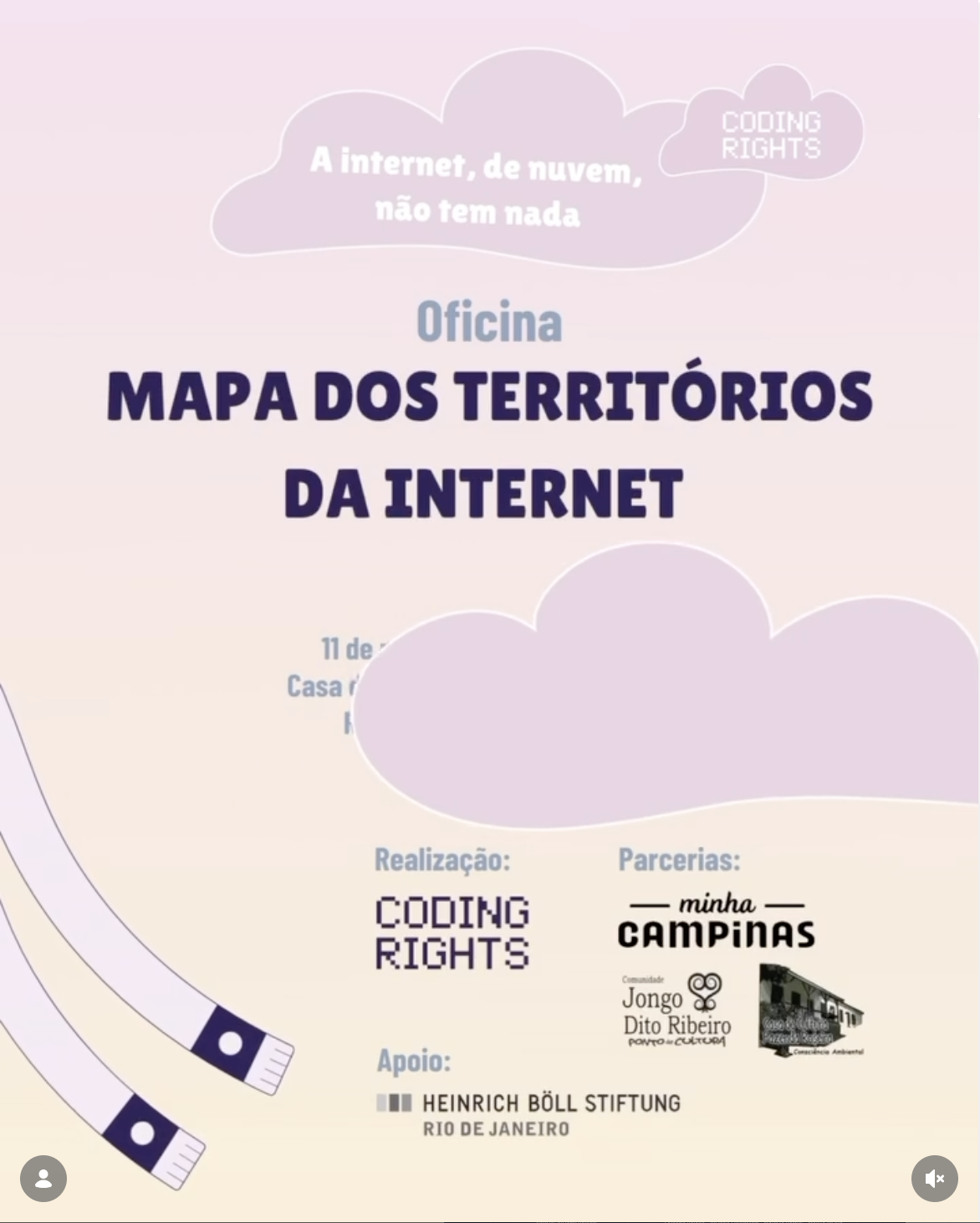
In November 2023, the Brazilian non-profit organization Coding Rights held a workshop on their project Map of Internet Territories in Campinas, South-East Brazil. When I arrived at the Fazenda Roseira, where the workshop would be hosted, the chairs had been placed in a circle and a Cartography poster was hanging on the wall. Mari Tamari, co-director of Coding Rights, presented the organization. Since 2015, Coding Rights brings a transfeminist perspective to digital technologies and their socio-environmental impact. Participants to the workshop were of different ages and backgrounds, particularly from electrical engineering, communications, and political activism.

The Cartografias da Internet is a map of internet infrastructures, representing the material aspect of the internet, made of cables, servers, computers, antennas, etc. Some of the questions that inspired the project are: Where is all the electronic waste being disposed of? Who benefits from connectivity, and who is left behind? What values are embedded in the algorithms? Who profits? Who is surveilled? What are the colonial relations that remain in digital technologies? Users can navigate the map by clicking on graphic icons to read in-depth information about each element mapped: extraction of mineral resources, internet connection ratio per inhabitant, connectivity infrastructures, labour, mainstream hardware and software producers, main destinations of electronic waste, highest concentration of servers, and consumption of water and energy in relation to digital technologies.
The Map of Internet Territories makes digital colonialism visible, by showing how the infrastructures of the internet are built upon the scaffolding of European settler colonialism. Digital colonialism, introduced by Brazilian scholars Deivison Faustino and Walter Lippold, identifies the power relations between ‘Global North’ and ‘Global South’ in internet infrastructures – a continuation of colonial relations through infrastructures, at the different stages of design, development, distribution, and waste disposal. The map shows why “having bad connection” has rarely been a problem for me, as a European, but was mentioned by more than one participant at the workshop. Europe has the highest concentration of internet connection ratio per habitant and concentration of servers, similarly to the US – where mainstream hardware and software producers are based. Brazil is fully pink, indicating it is a place where mineral resources are extracted; Gold and Tantalum in Minas Gerais, Goiàs and the north, where Aluminum, and Copper are also extracted. The servers are concentrated in the South-East part of the country, an extension, one could say, of the inequalities between the northern and southern parts of Brazil. In this sense, I see Coding Rights’ Cartography of the Internet as a cartography of infrastructural inequalities.
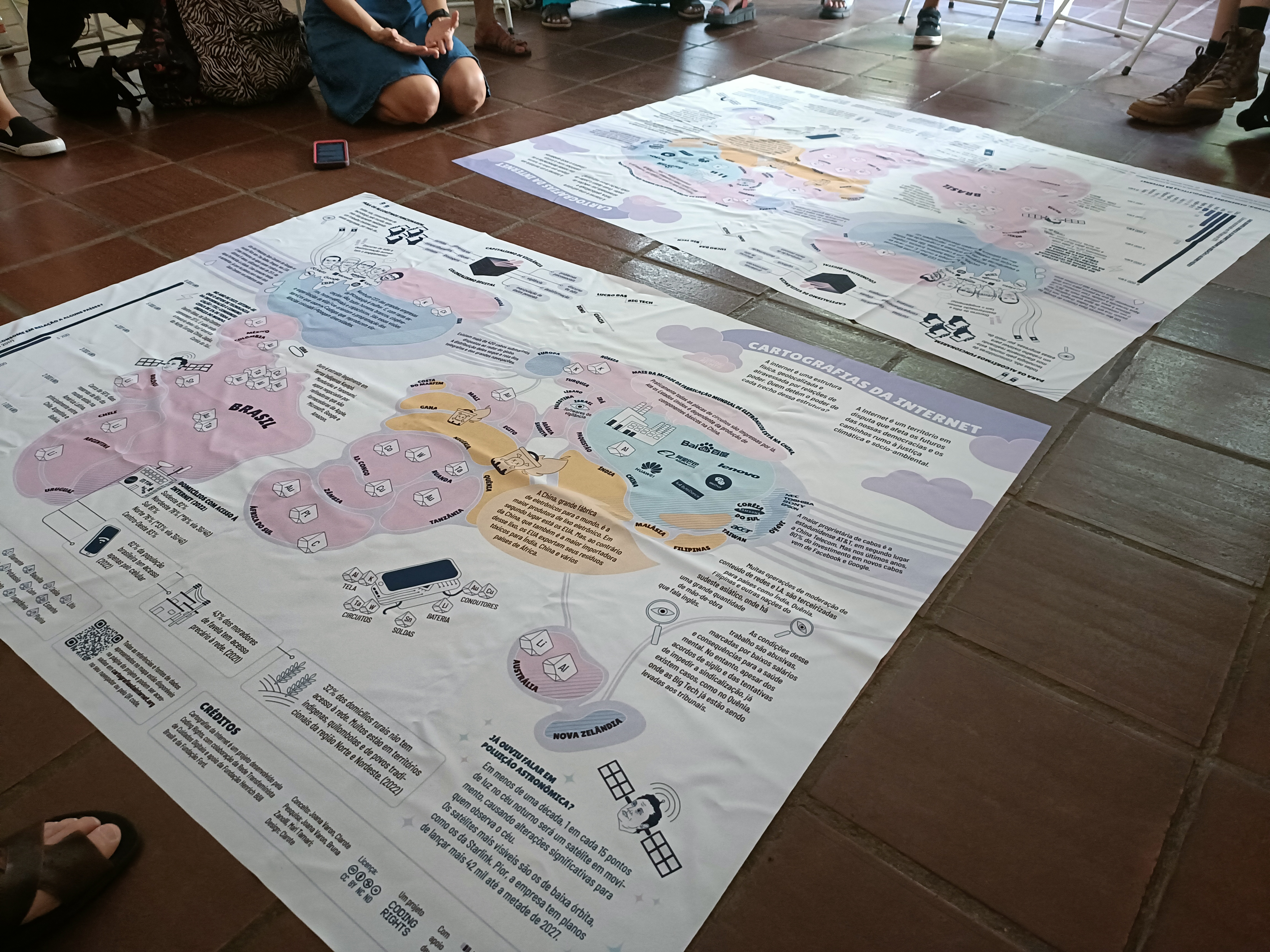

We live in deeply unequal societies. Structural inequalities are the systematic and institutionalized disadvantages that certain social groups face relative to others regarding access to resources, opportunities, and rights. They are rooted in policies, social norms, laws – and infrastructural choices. This is where the concept of infrastructural inequalities becomes relevant. Infrastructural inequalities identify the structural forms of inequality that are reproduced by, and embedded within, infrastructures. These have already been recognized in relation to infrastructures for water, electricity, or transportation. Access to clean water and reliable electricity is unevenly distributed, for example : poorer neighborhoods often experience more precarious electricity supply and, consequently, less stable internet connection. Likewise, as shown on a macro-level (though not necessarily exhaustively) by Coding Rights’ Cartography, the infrastructures of the Internet are unevenly distributed.
Today, we witness a massive shift of public governance towards data-driven infrastructure. These data infrastructures with regulatory functions – such as digital identity systems, biometric databases, education technologies and digital health - increasingly mediate access to citizenship, mobility, and care. As recounted by researcher Virginia Eubanks, algorithmic-driven decision-making systems are presented as objective, but they make mistakes, and those mistakes are patterned. The three case studies analysed by Eubanks – state implementation of automated eligibility systems, coordinated databases, and predictive risk models in the US - show that these mistakes disproportionally affect the poor through biased predictive algorithms. These Regulatory Data Infrastructures – by shifting decision-making to biased algorithmic systems – contribute to automating inequality.
Beyond algorithmic bias, investigating infrastructural inequalities allows us to relocate inequality from the software to the infrastructural level, including the material level of data infrastructures – the hardware components – as well as the institutional arrangements – standards, policies and protocols that define the rules of functioning of regulatory data infrastructures. While these systems are often promoted as efficiency-improving and security-enhancing solutions, I cannot help but wonder: for whom do these regulatory data infrastructures improve access to resources, opportunities and rights, and for whom do they (re)produce more hurdles and challenges? In other words, do regulatory data infrastructures (re)produce (infra)structural inequalities?